
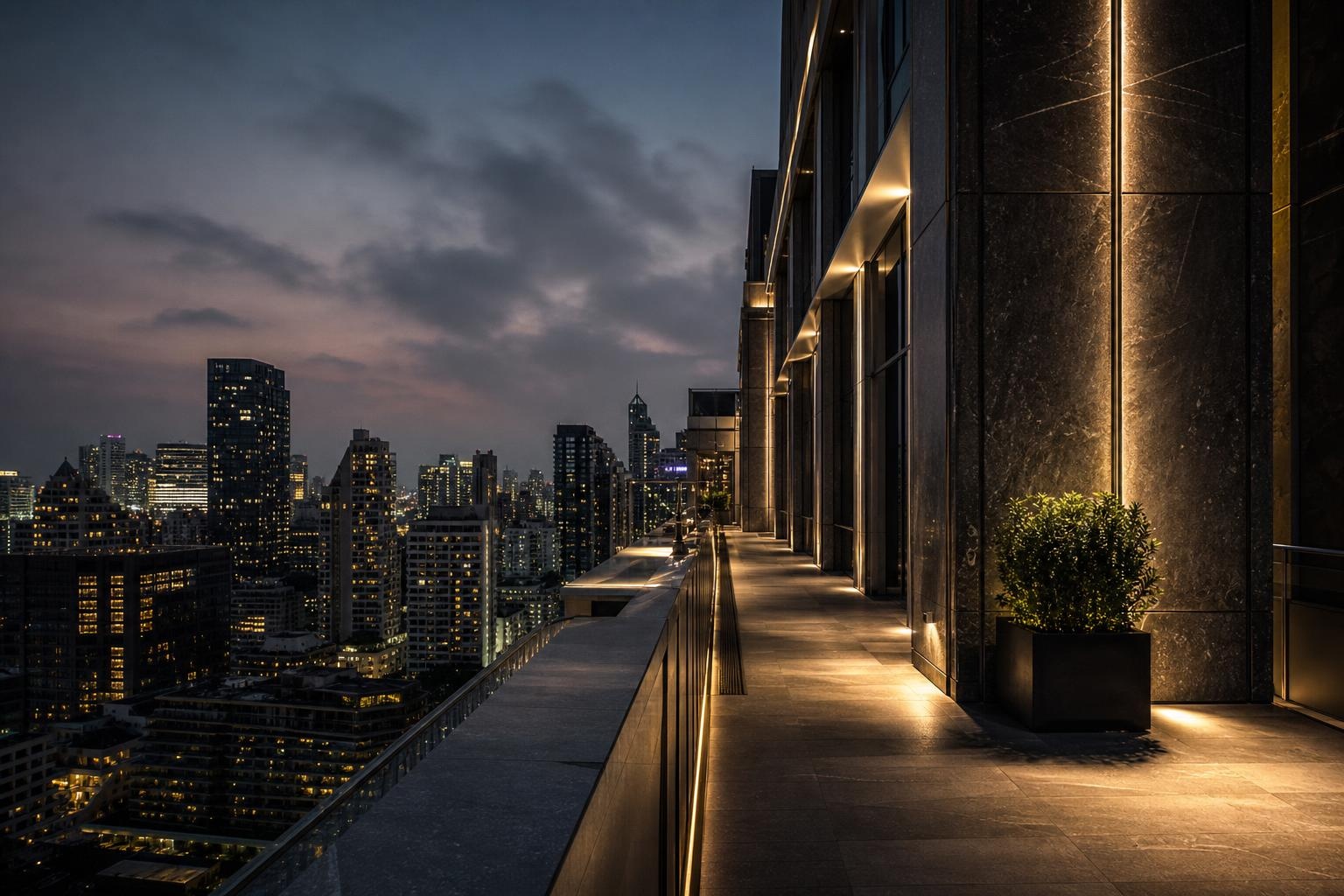
Good rooftop lighting is rarely the part of an evening that announces itself. You notice it indirectly: the route to the table is clear, faces remain easy to read, the menu is usable, and the skyline still feels like the main event. Poor lighting does the opposite. A bright source enters your field of view, reflective surfaces flare, the horizon disappears, and a space that looked atmospheric in photographs becomes tiring in person.
That makes rooftop lighting design more than decoration. It is the quiet system that connects safety, comfort, food, conversation and the view. For guests, learning to read that system offers a better way to judge a rooftop than simply asking whether it looks dramatic after dark.
The best-lit rooftop is not necessarily the brightest
Brightness is easy to add. Balance is harder. A rooftop has to illuminate steps, changes in level, service routes and table surfaces without turning every fixture into a competing focal point. It also has to preserve enough darkness for the city beyond the edge to remain legible.
The useful distinction is between light that helps you do something and light that merely fills space. The Five Principles for Responsible Outdoor Lighting, developed jointly by DarkSky International and the Illuminating Engineering Society, frame good outdoor lighting as useful, targeted, low-level, controlled and warm-colored. For a rooftop guest, those principles translate into a simple question: does each layer of light have a job?
A shielded step light has a clear job. So does a small pool of light over a menu or a discreet marker at a change in floor level. A bare lamp aimed toward seated guests is harder to justify, especially when it produces glare and makes the view behind it harder to see.
Read the space in four layers
You do not need a lighting plan or technical vocabulary to understand a rooftop after dark. Look at four layers in order.
1. The route
Start with the arrival. Can you understand where to walk from the lift or stair door? Changes in level should be visible without relying on decorative light alone. A well-lit route feels continuous: entrances, steps and circulation paths make sense before you reach the table.
2. The table
Next, look down. You should be able to identify food, read a menu and find your belongings without holding a phone torch over the table. That does not require a bright dining room. Local, directed light can support the task while leaving the wider setting calmer.
3. The faces
Conversation changes when one person is backlit by a strong feature wall or when a downlight creates deep shadows across every face. Soft light from more than one direction usually feels easier than a single intense source. The test is practical: can everyone at the table make comfortable eye contact without squinting?
4. The horizon
Finally, look outward. Reflections on glass, unshielded lamps and bright surfaces near the edge can compete with the city view. If you can move your head slightly and a large flare disappears, the problem may be one badly positioned source rather than the whole scheme. Choosing a seat with the light behind or beside you can make a surprising difference.
A five-minute guest audit
Rooftop lighting often changes during the evening, so judge it in motion rather than from one photograph. A quick audit can reveal whether the space will suit your plan.
- On arrival: check whether the route, steps and edges are clear.
- At the table: see whether menus and food are readable without extra light.
- Facing the view: notice whether fixtures or reflections sit directly in your sightline.
- During conversation: check whether faces are visible and the light feels stable rather than distracting.
- Later in the evening: notice whether the venue dims, changes color or introduces moving light as the atmosphere shifts.
This last point matters because a rooftop can work beautifully for an early dinner and feel very different once music and event lighting take over. If conversation is central to the evening, the same questions used when choosing a rooftop business dinner also apply to a date, a family meal or a long catch-up with friends.
Why reflections matter as much as fixtures
On an exposed rooftop, light does not stop at the lamp. It bounces from pale stone, polished metal, wet paving and glass. A fixture that appears modest on a dry surface can feel stronger after rain, while an illuminated wall may become a second light source in a window.
This is one reason weather-resilient design and lighting should be read together. Drainage, shelter and material transitions affect comfort during wet weather, while the finish of those same materials affects how the space looks at night. Our guide to rain-ready rooftop design in tropical Asia explains the physical layer; lighting reveals how that layer performs after dark.
The International Commission on Illumination’s 2025 position statement on obtrusive light and light pollution also identifies glare, motion, saturated colors and changing illumination levels as potentially disruptive. In hospitality terms, restraint is not the absence of design. It is the decision to put light where it adds information, atmosphere or safety and to keep it out of the guest’s direct view where possible.
Warm light helps, but color is not the whole story
Warm-toned light often feels compatible with food, skin tones and a slower evening atmosphere. It can also reduce the prominence of the lighting itself compared with very cool, blue-rich sources. Yet color temperature alone does not tell you whether a rooftop is well designed.
A warm lamp can still glare if it is too bright or poorly aimed. A cooler task light can still be useful if it is shielded, limited and placed carefully. The CIE cautions that correlated color temperature is not, by itself, a reliable measure of the biological effect of a light source. For guests, the more honest assessment combines color with direction, intensity, timing and contrast.
Look for a hierarchy rather than one uniform wash: clearer light on routes, gentle light at tables, selective emphasis on materials or planting, and enough darkness near the horizon for distance to remain visible.
Lighting changes photography, too
A dramatic rooftop can be surprisingly difficult to photograph when the foreground is much brighter than the skyline. Phones may expose for the lamp or table, pushing the city into darkness; expose for the skyline, and nearby faces or objects may lose detail.
Before increasing screen brightness or switching on a flash, change position. Move away from a bare source, use a darker wall as a background, or frame the view without a bright table lamp in the corner. Reflections often improve when the camera is closer to the glass and angled away from nearby lights. The fuller Rooftop Asia photography guide covers low-light exposure, reflections and considerate shooting in shared spaces.
What to ask when lighting could shape the evening
Most bookings do not require a technical conversation. A few ordinary questions are enough when the occasion depends on a particular mood:
- Is the outdoor area softly lit for dinner, or does it become club-like later?
- Are there quieter tables away from feature lighting or screens?
- Can the menu be read comfortably at outdoor tables?
- Does the venue use moving, flashing or highly saturated light during events?
- Is there an indoor alternative with a similar view if the outdoor lighting or weather does not suit?
Answers may change by event and time, so treat recent first-party information as more useful than an old photograph. A venue’s early-evening images may not represent its later program.
The simple test: can the light step back?
The strongest rooftop lighting design does several jobs while allowing the setting to lead. It makes movement legible, gives food and faces enough clarity, and lets architecture appear in layers. Then it steps back so the skyline, weather and company can hold your attention.
When choosing a rooftop in Asia, do not judge the night by brightness alone. Read the route, table, faces and horizon. Notice reflections. Watch how the scene changes after sunset. The better the lighting, the less likely you are to spend the evening thinking about it.