
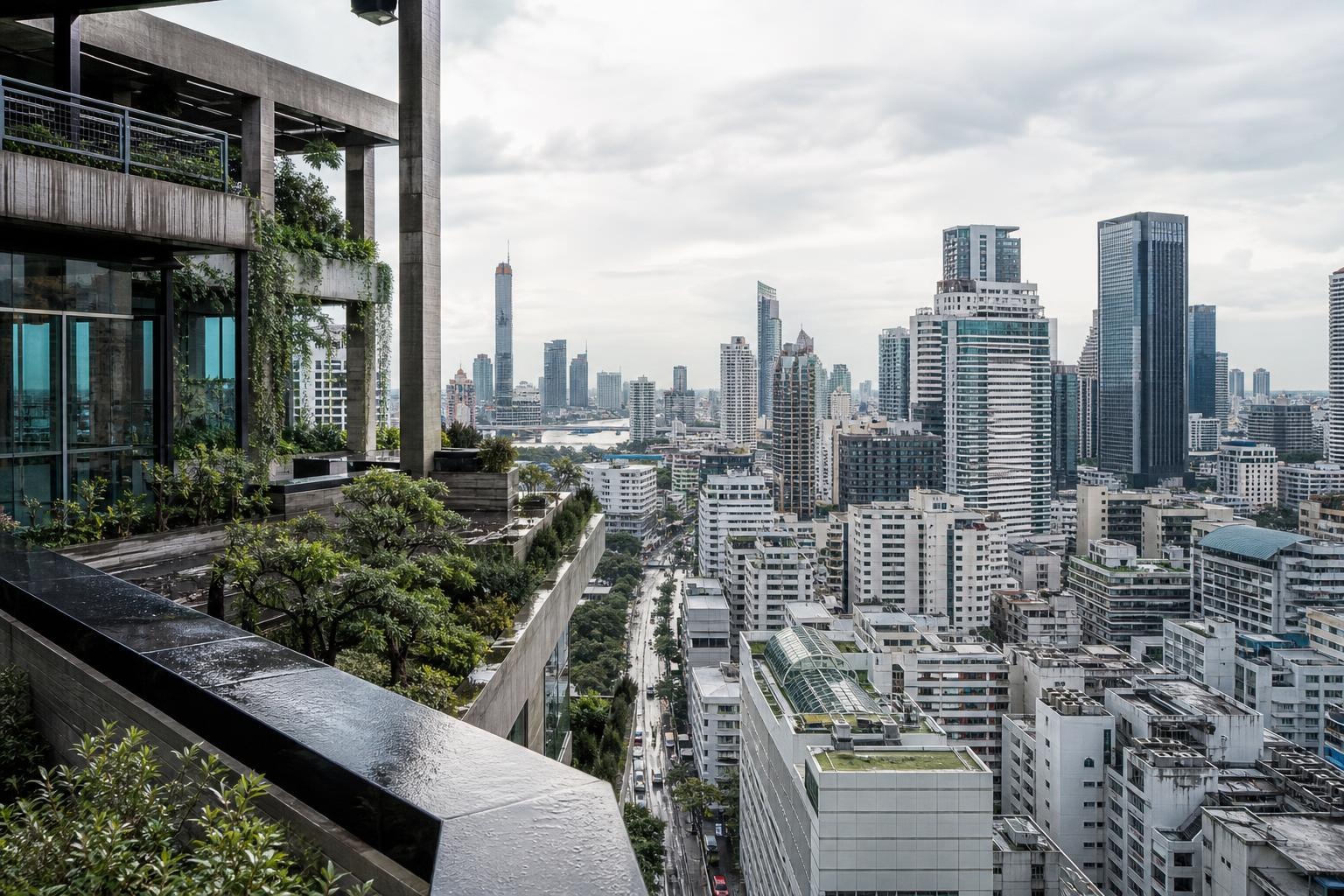
A rooftop can look effortless on a dry evening: open sky, a clear horizon and a table placed exactly where the view feels widest. Rain reveals the harder work. Water changes how guests arrive, where they pause, which surfaces feel secure and whether the venue can keep its character when everyone moves under cover.
That is why rain-ready rooftop design is not simply a matter of adding a roof. In tropical Asian cities, the most convincing spaces balance exposure and refuge. They still feel connected to the weather and skyline, but they give people a legible route, a comfortable fallback and a reason to stay when conditions shift.
Rain is a design test, not just a weather event
A sudden shower puts several systems under pressure at once. Water needs somewhere to go. Wind can push rain beyond the edge of a canopy. Guests who arrived separately converge on the same covered zone. Staff may need to reset furniture, protect equipment and redirect circulation within minutes.
Public technical guidance makes the underlying stakes clear. Singapore’s Building and Construction Authority Green Mark criteria are tailored to a tropical climate and explicitly treat climatic response, ventilation and wind-driven rain as design considerations. Hong Kong’s Drainage Services Department guidance on roof greening highlights drainage blockage, waterlogging, saturated loads and wind effects as issues that require professional assessment. A hospitality rooftop is not the same as a public green-roof project, but the principle carries across: weather performance is part of the architecture, not decoration added at the end.
Six details that make a rooftop easier to use in the rain
1. Shelter with a useful edge
Coverage works best when it protects more than the exact footprint beneath it. A deep canopy, screened edge or carefully placed louvre can reduce sideways rain and create a transition between fully exposed and fully enclosed space. From a guest’s perspective, the key question is simple: can you stand near the boundary without being caught by every gust?
This middle zone matters because it preserves the pleasure of being outside. A sealed room may be comfortable, but it changes the experience. A sheltered edge can retain air, sound and a sense of the city while offering genuine refuge.
2. A dry route, not only a dry table
A covered seating area is less useful if the lift lobby, reception point, washrooms or exit require a dash across an exposed floor. Good planning connects the important moments of the visit. Guests should be able to arrive, check in, reach shelter and leave without crossing service traffic or squeezing through a crowd gathered at the first dry doorway.
Look for routes that are obvious before the rain starts. Clear circulation usually feels calmer in fair weather too, because people do not need to negotiate around tables or ask staff where to go.
3. Drainage that stays out of the drama
The best water management is often quiet. Falls in the floor direct runoff away from doors and seating. Channels sit where they will not catch heels or interrupt movement. Downpipes and outlets do not discharge into the guest route. Edges are detailed so that water does not sheet across a threshold.
Guests do not need to inspect engineering drawings to notice the result. Watch what happens at the first sustained shower: do puddles form near the entrance, does water collect under chairs, or does the surface clear predictably?
4. Materials that still make sense when wet
Glossy surfaces can look striking at sunset and become less reassuring once covered in water. Texture, joints and changes of material help people read where to place their feet. The same principle applies to steps, ramps and raised platforms, especially when lighting is low.
This is not a cue to judge safety by appearance alone. It is a guest-level reading of design. A space that makes level changes easy to see, keeps routes uncluttered and avoids surprise transitions feels more composed when the weather turns.
5. Flexible zones instead of a single retreat
If every outdoor guest must move into one enclosed room, the atmosphere can change abruptly. A more adaptable layout offers degrees of cover: a protected perimeter, a semi-open section and an interior fallback. Furniture that can be regrouped without blocking movement helps the team respond without making the evening feel like an evacuation.
Flexibility also supports different reasons for visiting. A couple may prefer a quiet protected corner, while a larger group values space to remain together. Design is doing more than keeping people dry; it is preserving the social shape of the booking.
6. Air movement without a wind tunnel
Protection from rain should not automatically mean still, heavy air. Openings, screens and the relationship between sheltered and enclosed areas can help a space remain breathable. At the same time, an unbuffered corridor may accelerate gusts and carry rain deep into the plan.
There is no universal arrangement because tower height, orientation and surrounding buildings all matter. For guests, the useful sign is balance: the protected area should feel connected to outside conditions without turning every breeze into a disturbance.
Open-air character can survive under cover
Rain-ready design is sometimes mistaken for compromise. In practice, shelter can sharpen a rooftop’s identity. Framed openings can make a city view more deliberate. A canopy can give the ceiling a rhythm. Rain on planting or a controlled water chain can add movement and sound. Reflections can deepen the evening’s lighting rather than wash it out.
The distinction lies in whether these elements belong to one spatial idea. A collection of umbrellas added wherever they fit may solve an immediate problem but often fragments sightlines and movement. Integrated cover feels calmer because structure, lighting, drainage and furniture are working together.
For another way to read the relationship between enclosure, elevation and views, Rooftop Asia’s guide to rooftop design in dense Taipei neighbourhoods examines how these choices shape the experience before a menu is opened.
A five-minute design check before you settle in
You can read a rooftop quickly without turning the evening into a building inspection. On arrival, notice:
- whether the route from the lift to shelter is continuous and easy to understand;
- whether covered seats still have airflow and a visual connection to outside;
- where water is likely to collect if rain begins;
- whether steps and floor changes remain visible after dark;
- whether staff have more than one sensible place to move guests;
- whether the protected area feels intentional rather than temporary.
If weather is central to your decision, ask the venue a direct question before booking: what happens to your specific table if rain arrives? That is more useful than asking only whether the rooftop has an indoor section. A fallback may exist but have a different menu, view, atmosphere or capacity.
What architecture cannot promise
No design can guarantee that an exposed rooftop will operate normally through every storm. Wind, lightning, intense rain and local safety procedures can all change the plan. The better question is whether the venue communicates its limits clearly and has an orderly response when conditions cross them.
Weather resilience therefore sits between architecture and operations. Thoughtful thresholds, drainage and flexible zones create options; trained staff and clear booking policies determine how those options are used. Travellers planning around another climatic extreme can also use our guide to rooftop evenings in hot weather, where timing and fallback spaces matter for different reasons.
The best rainy-evening design feels natural
A successful tropical rooftop does not pretend the weather is absent. It lets guests feel the air, notice the rain and remain connected to the city, while making movement and shelter easy. The evidence is not a dramatic feature. It is the absence of confusion: no bottleneck at the door, no improvised route through puddles, no sudden loss of atmosphere when the first drops arrive.
When shelter, drainage, material, airflow and service planning reinforce one another, rain becomes part of the evening rather than the end of it. That is the quiet value of rain-ready rooftop design: it protects the experience without flattening it.