
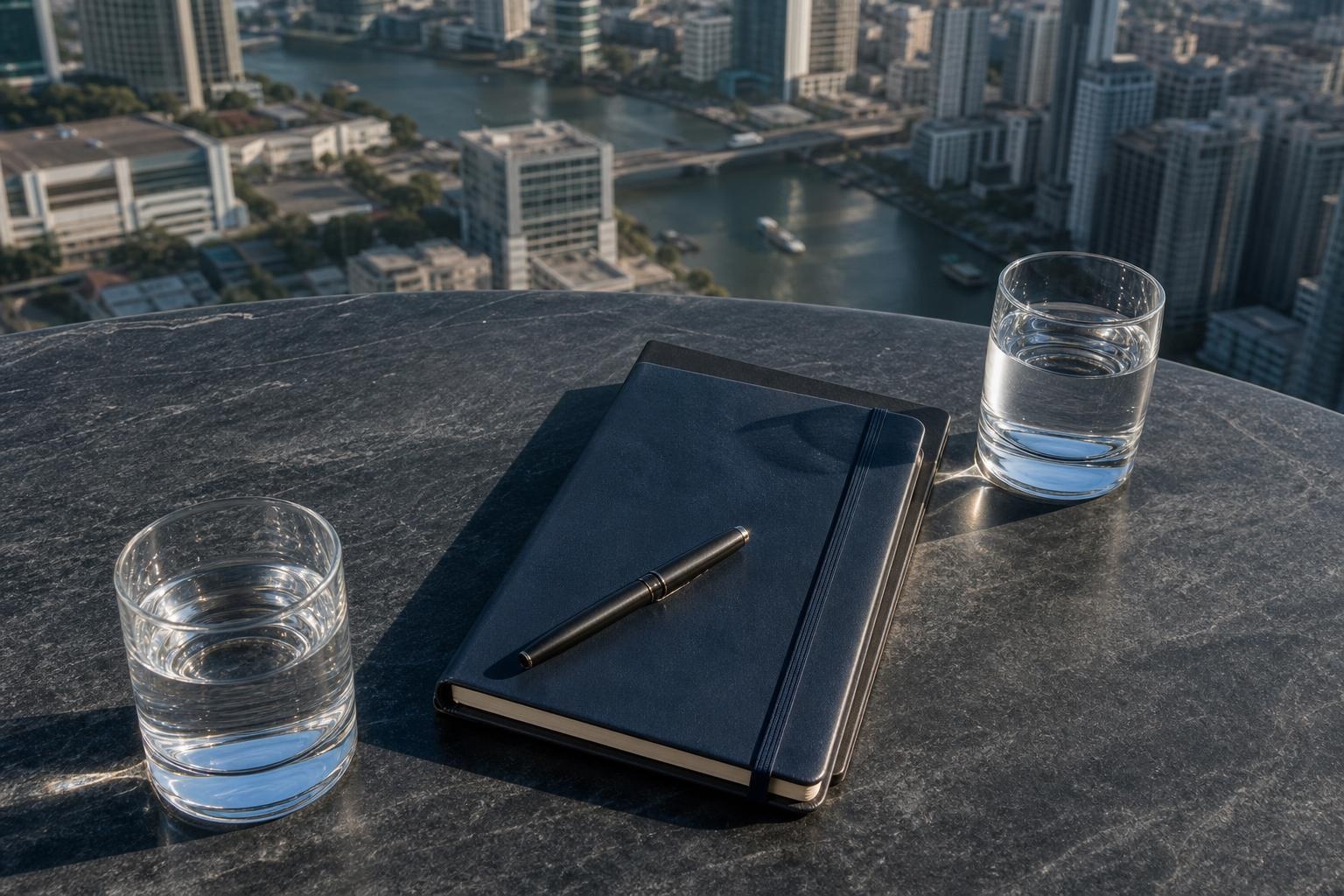
A rooftop business dinner has two jobs. It should feel more considered than an ordinary meeting, and it should still let people hear, eat and leave without friction. The skyline can help set the tone, but it cannot rescue a table that is too loud, a menu that excludes a guest or an outdoor booking with no weather plan.
The best choice is therefore not necessarily the highest venue or the most photographed terrace. It is the rooftop that makes the purpose of the evening easy: conversation, introductions, a relationship-building meal or a relaxed close to a day of meetings. This guide offers a practical way to choose one across Asian cities without relying on a generic list of bars.
Write the brief before searching for the view
Start with one sentence that describes what must happen at the table. “Six colleagues need a quiet dinner after a conference” is a better brief than “somewhere impressive.” So is “two visiting clients need a relaxed meal near their hotel, with a reliable alcohol-free choice.”
That sentence creates useful filters. The number of guests affects table shape and booking terms. The purpose determines how much privacy and quiet matter. The location influences whether people arrive calm or late. Dietary, mobility and language needs may narrow the shortlist before design or altitude enters the decision.
Separate the brief into three levels:
- Non-negotiable: headcount, date, neighbourhood, budget approach, dietary requirements, step-free access and a weather alternative.
- Conversation conditions: music level, table spacing, seating shape and whether the group can remain together.
- Atmosphere: open-air exposure, city outlook, formality, lighting and how lively the venue becomes later.
This order prevents the view from becoming the first filter and the guest experience an afterthought.
Test sound and seating with one direct question
Business dinners fail quietly when conversation becomes work. A polished photograph cannot show how strongly music carries across a terrace, whether speakers face a particular row of tables or whether a venue becomes club-like after a certain hour.
Ask the reservation team: “Which seating area is best for a business conversation at this time?” The answer is more useful than asking whether the venue is “quiet,” because it invites a specific recommendation. Follow with two details: whether the table is indoors or outdoors, and whether music or entertainment changes during the booking.
For four to six people, a compact round or square arrangement usually keeps the conversation shared more naturally than a long table. For a larger party, ask whether one table is guaranteed or whether the booking may be split. If the purpose is a presentation, negotiation or sensitive discussion, a rooftop bar may not be the right format at all; a private dining room with brief terrace access can be the stronger choice.
Timing matters too. An early dinner may offer a calmer room and the changing light. A later booking may inherit a busier bar atmosphere. Neither is automatically better. Match the rhythm to the work the evening is meant to do.
Make the outdoor plan resilient, not optimistic
A rooftop reservation should have a plan A and a plan B before the invitation is sent. Ask what happens if there is rain, strong wind, poor air quality or uncomfortable heat. “Indoor seating subject to availability” is not the same as a guaranteed alternative, especially for a group.
Official hot-weather event guidance from the UK Health Security Agency emphasizes access to drinking water and advance planning for heat. A business dinner is smaller than a mass event, but the practical principle still travels well: water, shade or indoor cooling, and a clear fallback should be part of the booking rather than a response to discomfort.
Rooftop design also affects how smoothly a venue can adapt. Covered transitions, drainage, shelter and flexible indoor-outdoor circulation are explored in Rooftop Asia’s guide to rain-ready rooftop design in tropical Asia. For the host, the key question is simple: can the table move without changing the character or terms of the evening?
Do not promise an outdoor table to guests until the venue has confirmed what the reservation includes. If the view is essential, build in a short terrace moment but keep the meal itself in the most dependable setting.
Confirm the whole route, not only the table
Accessibility on a rooftop is a chain: arrival at the building, entrance, lift, route to the table and access to a suitable toilet. A venue can advertise lift access while still requiring steps between an indoor room and the terrace.
Singapore’s Building and Construction Authority identifies an accessible entrance, an accessible toilet and a barrier-free route between them as core accessibility features. Regulations and building conditions differ across Asia, so use those elements as questions rather than assumptions.
Ask the venue to describe the exact route for the person who needs it. Check whether every planned part of the evening is accessible, including an outdoor area, private room or smoking-free route. Confirm where a car can stop and whether the final lift requires a separate entrance or staff escort.
Good hosting makes this information ordinary and private. Ask all guests for access or dietary requirements in the same neutral message rather than singling anyone out in front of the group.
Build a menu that keeps attention on the conversation
A broad menu is useful only when the kitchen can confidently serve the actual group. Collect dietary needs before booking, distinguish preferences from medical allergies and send the venue a written summary. For a serious allergy, do not rely on a menu icon alone.
The NSW Food Authority’s guidance for eating out with food allergies recommends communicating the allergy when booking and again when ordering. It also notes that staff and recipes can change. That double confirmation is a sensible hosting habit anywhere, while the venue remains responsible for explaining what it can safely provide.
For a group dinner, a limited set menu can simplify timing and payment, but it should not turn one guest’s meal into a visible compromise. Ask whether alternatives will arrive with the same course and whether shared dishes create cross-contact concerns. Avoid pre-ordering for someone with a medical requirement unless that person has approved the arrangement.
Choose a service style that supports the evening. Shared plates encourage interaction but can interrupt a discussion and complicate allergies. Individual courses create clearer pacing but may lengthen the meal. A concise menu with one or two genuine choices often strikes the best balance.
Host the drinks without making alcohol the agenda
A business dinner should work equally well for a guest who orders wine, a beer, a mocktail or water. Put still and sparkling water on the table early, and check that the alcohol-free list offers more than a sweet soft drink.
Rooftop Asia’s guide to choosing rooftop mocktails by flavour and structure offers a useful way to discuss zero-proof drinks without treating them as a lesser category. For the host, this also makes ordering smoother: ask the venue for one dry, food-friendly alcohol-free option and one brighter option before the group arrives.
Avoid packages that make alcohol consumption the value proposition unless every guest has chosen that format. If drinks are ordered individually, the host can set a relaxed pace by beginning with water and letting guests choose without commentary.
Control the final thirty minutes
The close of the meal shapes the memory as much as the arrival. Decide in advance who will receive the bill, whether the venue can keep it away from the table and how extras outside a set menu will be handled. Confirm service charges, deposits, cancellation terms and the accepted payment method while there is still time to solve a problem.
Allow a clear finish rather than letting the evening drift into a louder late-night service. If some guests want to stay, the formal dinner can still end at the agreed time. Arrange transport options, share the correct building exit and avoid leaving visiting guests to decode a large hotel or mixed-use complex alone.
The social details matter as well. Rooftop Asia’s rooftop bar etiquette guide covers photographs, shared viewpoints, seating and changing conditions. At a business dinner, the useful principle is restraint: take the group photo efficiently, keep devices away during the main conversation and do not let a viewpoint become a competition for seats.
The 24-hour confirmation
One day before the dinner, send the venue a compact written check:
- final guest count and arrival time;
- the exact seating area and conversation priority;
- the confirmed weather fallback;
- dietary and access requirements;
- menu or minimum-spend terms;
- billing contact and payment plan;
- dress, identification or entry rules;
- the best entrance, lift and drop-off point.
Then send guests only what they need: time, location, entrance guidance, dress expectations and a discreet way to share any unmet requirement.
A strong rooftop business dinner feels effortless because the host has already resolved the effort. Choose the venue for how well it supports the people and the purpose; let the height, light and skyline provide the memorable layer after the essentials are secure.