
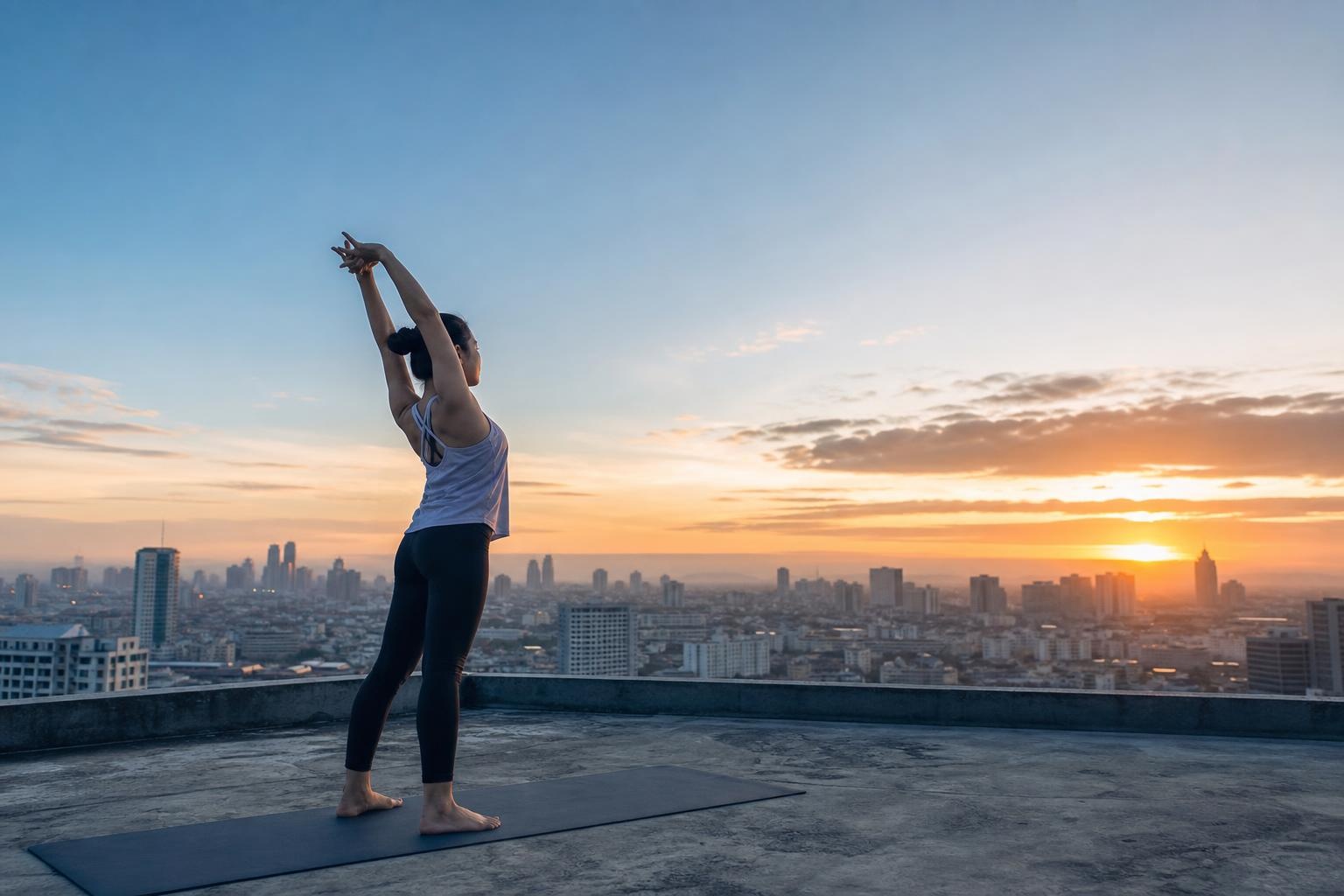
Rooftop yoga sounds simple: bring a mat upstairs, face the skyline and begin. In practice, the best sunrise sessions are shaped by details that have little to do with a difficult pose. Access may start later than dawn, a surface can feel hotter or rougher than expected, wind can change balance, and a clear-looking horizon can still coincide with poor air quality.
A better plan treats the roof as an outdoor environment first and a workout space second. Whether you are joining an organised class or arranging a quiet stretch with friends, the aim is not to chase a perfect sunrise photograph. It is to create a session that feels calm, comfortable and easy to leave if conditions change.
Plan the roof before the routine
Start by confirming that the space is genuinely available for exercise. A hotel, residence or office may have a roof deck, yet that does not mean guests can use it before normal opening hours or move furniture to make space. Ask who authorises access, when the lift begins operating, whether a staff member will be present and what happens if the roof closes because of weather.
The route matters too. Carrying a mat through service stairs in low light is a different proposition from taking a lift directly to a level entrance. Anyone organising a group should confirm step-free access, restroom availability and an indoor waiting point. The same questions used in our rooftop accessibility guide are useful here: do not assume that a rooftop reached by lift has a completely step-free route from the entrance to the exercise area.
Once upstairs, look beyond the view. Check for loose objects, wet patches, sharp changes in level, low obstacles and areas close to an unprotected edge. Keep the class comfortably away from parapets and circulation routes. A dramatic edge position adds nothing to the practice and creates an avoidable distraction.
Dawn, sunrise and early daylight are different sessions
“Sunrise yoga” can describe several lighting conditions. According to the US National Weather Service, morning civil twilight begins when the centre of the sun is six degrees below the horizon and ends at sunrise. That is a useful planning distinction: arrival during civil dawn may provide some natural light, but it is not the same as full daylight, especially when cloud, haze or surrounding buildings reduce visibility.
Use a current local forecast or astronomy service for the date and exact location, then work backwards from the published sunrise time. Avoid using a generic “6 a.m.” rule across Asia. Sunrise varies by city, season and longitude, while building access and local transport can shift the practical start even more.
| Phase | Best use | What to check |
|---|---|---|
| Civil dawn | Arrival, orientation and a gentle warm-up | Safe lighting, dry routes and clear edges |
| Around sunrise | The main standing or flowing sequence | Glare, wind direction and changing temperature |
| Early daylight | Floor work, a slower finish and departure | Direct sun, surface heat and the next rooftop booking |
This sequence is a planning framework, not a fixed timetable. A cloudy morning may become bright gradually, while a clear east-facing roof can move from cool shade to strong direct sun quickly. Build enough flexibility into the routine to shorten a section without making the session feel unfinished.
Read heat, air quality and wind together
Early morning is often chosen because it can be cooler, but “early” does not automatically mean comfortable. Humidity, low wind and radiant heat from exposed surfaces all affect how the space feels. The World Health Organization’s heat guidance recommends avoiding strenuous activity during the hottest part of the day, seeking shade and following official heat warnings. The US CDC likewise advises staying cool, hydrated and alert to symptoms of overheating.
For a rooftop session, translate that guidance into practical choices: keep water accessible, favour a gentler format when heat or humidity is high, and identify a shaded or indoor place before starting. If someone feels dizzy, weak, nauseous or unusually short of breath, stop the session and move to a safer environment rather than trying to complete the planned sequence.
Air quality deserves its own check. A beautiful dawn does not guarantee clean air. WHO notes that people can adapt the timing and location of physical activity to reduce exposure when pollution is elevated, with extra caution for people who have relevant health conditions. Check the local official air-quality service alongside the weather forecast, and use our guide to haze, mist and rooftop visibility to distinguish a disappointing view from a condition that may change the whole plan.
Wind can be equally decisive. Gentle airflow may feel welcome, but gusts can catch loose clothing, towels and lightweight mats, while making standing balances less predictable. Do not weigh a mat down with glasses, phones or other hard objects. Move to a sheltered approved area, simplify the practice or use the indoor fallback. Our rooftop wind planning guide explains why gusts matter more than a single average-wind number.
Choose a session that fits the surface
Rooftop floors are rarely designed as yoga-studio floors. Stone, tile, timber, composite decking and concrete can all change grip, cushioning and temperature. Ask the organiser what surface is used and whether participants need to bring a mat. If you are visiting independently, test a small area with your hand and shoe before unrolling anything.
A thicker mat can improve comfort on a hard surface, but it cannot correct an uneven or slippery one. Avoid placing mats across drainage channels, raised joints or routes used by staff. After rain or overnight condensation, wait for the approved exercise area to dry fully. The wider principles in our article on rooftop flooring also apply to movement: heat, grip and level changes are often felt before they are consciously noticed.
Clothing should suit movement, temperature and the building rather than the photograph. A light layer can help during a cool arrival and be removed as the roof warms. Secure anything that could blow away. Keep bags together in an approved area so they do not create obstacles or encourage people to leave the group near an edge.
A simple rooftop yoga run sheet
- The day before: confirm permission, access time, group size, surface, restrooms and the indoor alternative.
- Before leaving: check the local heat warning, air quality, rain forecast, wind and gusts.
- On arrival: inspect the route and exercise area before participants spread out.
- At civil dawn: use available lighting and begin with calm, low-complexity movement.
- At sunrise: adapt the main sequence to glare, wind and temperature rather than following the plan rigidly.
- After the session: clear every item, leave circulation routes open and depart before the space changes to its next use.
For a private group, nominate one person to make the weather decision and communicate it early. For an organised class, follow the instructor and venue’s rules. In either case, a concise message such as “roof confirmed,” “moved indoors,” or “cancelled because of conditions” is better than leaving participants to interpret separate forecasts.
Know when the indoor plan is the better plan
A sunrise is not a reason to override a closed roof, a heat or air-quality warning, lightning risk, strong gusts, a wet surface or uncertain access. Nor is it a reason to pressure someone to exercise outdoors when they do not feel well. The most thoughtful rooftop plan includes an indoor room, sheltered approved area or straightforward rescheduling option from the beginning.
That fallback does not make the morning less memorable. It removes the need for last-minute improvisation and lets the rooftop remain what it should be: a special setting when conditions support it, not a commitment that must be defended at any cost.