
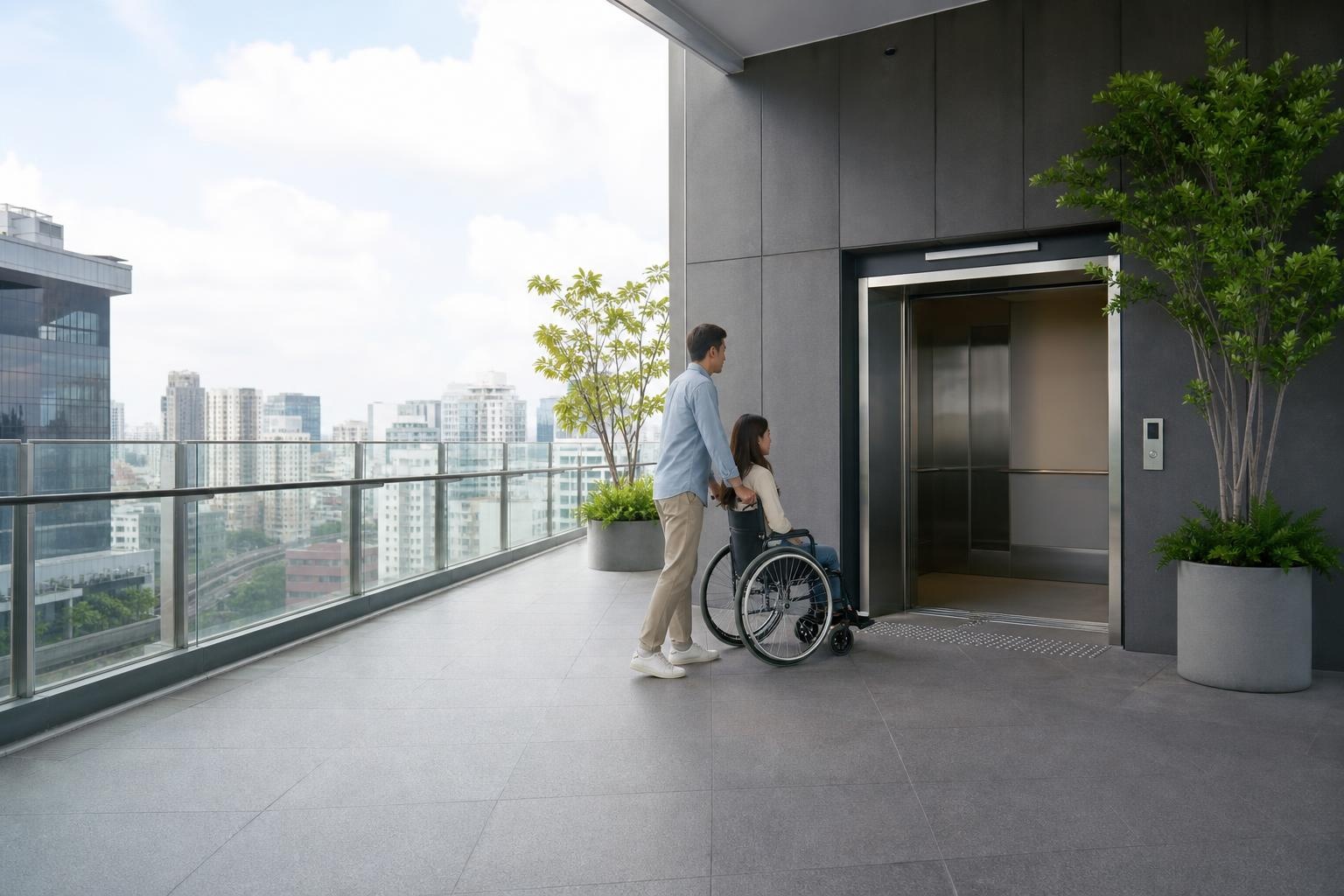
A rooftop can look easy to reach on a booking page and still involve a difficult route in practice. The lift may stop one level below. The accessible restroom may be in the lobby. A step-free entrance may lead to tall stools only, or a weather change may move service to a less accessible area.
That is why rooftop accessibility in Asia is best checked as a complete journey, not a single yes-or-no feature. The aim is not to find a perfect venue. It is to understand the route, the space and the support available well enough to make a confident decision before leaving.
Accessibility starts before the rooftop door
The United Nations Convention on the Rights of Persons with Disabilities places access to tourism and recreational venues within the wider right to participate in cultural and leisure life. For a guest, however, that broad principle becomes a very practical sequence: transport, entrance, reception, lift, final threshold, seating, restroom and exit.
Building standards and practices vary between countries, cities, properties and renovation periods. Even within one hotel, the public lobby and the uppermost outdoor level may not offer the same route. Treat every venue as a fresh check, especially when the rooftop occupies an older building, a converted space or more than one level.
Map the whole route in six questions
Ask for details in plain language. A useful answer should describe the route rather than simply repeat the word “accessible.” These six questions cover most of the surprises that matter:
- Is there a step-free route from the street or drop-off point to the main entrance? If the accessible entrance is separate, ask where it is and whether staff need to unlock it.
- Does the lift reach the exact level where guests are seated? “Lift access” may still end at a short flight of steps.
- Are there thresholds, ramps, narrow doors or uneven outdoor surfaces on the final approach? Request measurements when clearance is important.
- Is an accessible restroom available on the same level? If not, ask how far away it is and whether the route remains step-free.
- Can the venue reserve suitable seating? A level route is less useful if every available place is a fixed booth, low lounge seat or high bar stool.
- What changes during rain, strong wind or a private event? The backup area may use a different route or layout.
Official destination resources can help with the wider journey. The Tokyo Accessibility Guide, for example, emphasizes advance planning and communication alongside transport information. Use city guidance for the trip to the building, then confirm the rooftop-specific route directly with the property.
Check the final lift, threshold and transfer points
The last few metres are often where a general property description becomes unreliable. Ask whether the lift doors open directly onto the rooftop level, whether a platform lift is involved and whether staff assistance is required. If there is a ramp, useful details include its location, surface and whether the route is kept clear during busy service.
Think about transfer points as well. A taxi may stop at a kerb without a dropped section. Security screening may use a narrow gate. A host stand may sit behind a heavy door. None of these details automatically rules out a visit, but knowing them early lets the guest decide what is comfortable and what assistance to request.
For groups, designate one person to hold the confirmed route and booking contact. That avoids making the guest repeat access needs at every stage of the evening.
Choose seating for comfort, not just the view
Rooftop layouts often mix high tables, low sofas, dining chairs, fixed booths and standing areas. Ask what can actually be reserved. A standard-height table with a movable chair may be more practical than the most photogenic edge seat.
Details worth confirming
- whether chairs can be removed or repositioned;
- whether a wheelchair can remain at the table without blocking circulation;
- whether the surface is level and firm;
- whether there is space for a mobility aid beside the seat;
- whether a companion or support person can sit alongside;
- whether service can be brought to the table instead of collected from a bar.
Accessibility also includes sensory comfort. Ask about amplified music, flashing effects, crowd density and quieter seating. Clear lighting on the route can be as important as atmosphere; our guide to rooftop lighting design explains how layered light affects movement, faces and the view after dark.
Plan for weather without losing the accessible route
Open-air venues can change quickly. A dry, level terrace may become slippery in rain, while wind can make lightweight furniture or loose belongings difficult to manage. Check whether the covered alternative is reached by the same lift and whether it has comparable seating and restroom access.
A venue does not need to promise perfect weather. It should be able to explain its operating plan. Before leaving, check the forecast and decide what conditions would trigger a change; the Rooftop Asia wind guide offers a practical way to read sustained wind and gusts. It is also useful to notice how shelter, drainage and indoor-outdoor transitions work, as described in our guide to rain-ready rooftop design.
Send one clear message before booking
A short written request creates a record and gives the venue time to check with operations staff. Adapt the sample wording to the guest’s own date, time and access requirements:
Hello, I would like to visit on Tuesday at 7 pm. Could you please confirm a step-free route from the entrance to the rooftop seating area, including the final level? I use a wheelchair and need a standard-height table with space to remain seated in it. I would also like to know whether an accessible restroom is available on the same level. If weather changes the seating plan, is the alternative area reached by the same step-free route? Please tell me where the best drop-off point is and whether I should ask for a staff member on arrival. Thank you.
Specific questions are easier to answer than a broad request. If the reply is unclear, ask for a photograph of the final threshold or a call with the duty manager. Do not rely on an old review for a route that may have changed after renovation or a new seating layout.
Use the answer to make your own decision
Universal design aims to make spaces usable by as many people as possible. Singapore’s Building and Construction Authority publishes official universal design guidance that illustrates how accessibility involves the wider built environment, not one isolated feature. A guest still needs venue-specific information, because personal requirements and real operating conditions differ.
A confident booking comes from an honest description of the route and a plan that respects the guest’s preferences. Confirm the details shortly before the visit, keep the venue contact handy and choose a simple alternative if the answers do not provide enough certainty. The best rooftop evening begins with access that has been considered from street level to the final seat.