
Kathmandu hotel rooftops are becoming more than interchangeable places for a drink with a view. A small group of international hotels now uses the top of the building to express a distinct identity: one leans into Latin-inspired dining and music, another frames cocktails around the valley and mountains, and a renovated hotel treats its pool deck as a social hub.
This is not a claim that every rooftop in the city has changed. It is a snapshot of three current, officially documented formats. Together, they show how Kathmandu’s hotel rooftop scene is widening its vocabulary without losing the open-air outlook that draws people upstairs in the first place.
The rooftop is becoming part of the hotel concept
For years, a hotel rooftop could be marketed with three simple ingredients: height, sunset and a broad city view. Those remain powerful, but they no longer explain the whole product. Newer lifestyle brands and refreshed properties increasingly use the rooftop to communicate what kind of hotel they want to be after dark.
That shift matters because it changes how travellers choose. The question is no longer only, “Which rooftop has the best view?” It can also be, “Do I want a meal, a poolside cocktail or a more energetic social stop?” The answer affects when to arrive, how long to stay and whether the rooftop should lead the evening or simply finish it.
Rooftop Asia has tracked the same broader move in its guide to rooftop trends reshaping Asia in 2026: elevated spaces are being asked to do more than provide scenery. Kathmandu offers a compact city-level example of that trend.
A restaurant-led rooftop: Cariño at Moxy Kathmandu
Cariño – Terraza Latina is presented by Moxy Kathmandu as a 12th-floor rooftop bar and restaurant rather than a view deck with a short snack list. Marriott’s current venue page describes Nepali street-food favourites alongside Southeast Asian-inspired bites, signature cocktails, music and live entertainment.
The combination is notable. “Latin-inspired” shapes the venue’s identity, but the food description keeps Kathmandu and the wider region in the frame. That makes the rooftop an active dining and nightlife concept, not merely an observation point above the hotel.
Its listed schedule also stretches from midday into the night, with later closing on Friday and Saturday at the time of checking. That range allows the same space to behave differently across the day: lunch and a city outlook, an early poolside stop, or a later music-led visit. Travellers should still confirm the live hours and any event programme directly, because those are operational details rather than permanent features.
A view-led pool bar: Sukra Bar at Mercure
Sukra Bar at Mercure Kathmandu Sukedhara Heights uses a different formula. Accor identifies it as a rooftop pool bar with panoramic views across the Kathmandu Valley and toward the mountains. The hotel describes cocktails, an infinity pool and musical entertainment, and its current FAQ says the rooftop is open to local visitors as well as hotel guests.
Here, the outlook remains central, but the pool-bar format gives the view a particular rhythm. It suggests a longer, slower visit than a stand-alone late-night bar: the scenery, water and drinks are designed to share the same experience. That does not mean every guest receives the same conditions. Mountain visibility, weather and private functions can change what the rooftop feels like on a particular day.
The useful signal is not a superlative. It is the decision to make the rooftop accessible beyond the room key. When a hotel explicitly welcomes local visitors, the top floor can participate in the city’s social life rather than operating only as an amenity for overnight guests.
A rebrand that repositions the sky deck
ZING Sky Pool Bar & Deck at Hyatt Centric Soalteemode Kathmandu shows how a rooftop can change role when the hotel beneath it is refreshed. Hyatt announced the property’s debut under the Hyatt Centric brand in January 2025 after an extensive renovation of the former Hyatt Place Kathmandu.
In that announcement, Hyatt describes ZING as a poolside retreat with Kathmandu views and a menu drawing on local and international influences. The rooftop sits within a wider repositioning that also includes renovated social and event spaces. In other words, the bar is not an isolated amenity; it forms part of the hotel’s new public-facing identity.
This matters editorially because it separates a physical rooftop from the way it is programmed. A familiar deck can feel new when the food, drinks, design, music and intended audience are reconsidered together. For visitors, a current official page is therefore more useful than an old review that may describe the previous hotel concept.
Three formats, three different reasons to go
These venues are not interchangeable, even though all three combine elevation, drinks and an outdoor component.
- Choose Cariño when the restaurant concept, food and music should carry the evening.
- Choose Sukra Bar when a poolside setting and the valley-to-mountain outlook are the main attraction.
- Choose ZING when a contemporary hotel social space and a refreshed sky-deck identity fit the plan.
The comparison is intentionally about format, not ranking. A dramatic view cannot compensate for the wrong atmosphere, and a strong menu may matter more than height when dinner is the priority. Kathmandu’s rooftop scene becomes more useful when these differences are visible before a guest books.
What still needs a live check
Trend analysis should not turn changeable venue information into fixed promises. Opening hours, event calendars, guest access, pool use, age rules, reservation terms and dress guidance can all move independently of the underlying concept.
Before going, check four things on the venue’s current first-party channel:
- whether outside visitors are accepted on the chosen date;
- whether the pool area is included, restricted or reserved for hotel guests;
- whether music, a private event or weather will change normal service;
- whether a table booking carries a deposit, minimum spend or time limit.
Kathmandu’s air and cloud conditions can also alter a mountain-facing view. Rooftop Asia’s practical guide to reading rooftop visibility before you go explains why a clear weather icon alone does not guarantee a crisp horizon.
A broader hospitality signal, with limits
The city’s hotel pipeline gives this rooftop evolution a wider context. In June 2026, the Nepal Tourism Board announced planned Ritz-Carlton and Westin developments in Kathmandu, scheduled for 2031. That announcement signals continued investment in international hospitality, but it does not promise that those future hotels will include public rooftops. It should not be read as one.
What can be said now is narrower and more useful: existing hotels are already treating their upper levels as differentiated food, drink and social destinations. The three examples above move from restaurant-led nightlife to a mountain-facing pool bar and a reworked lifestyle-hotel deck. That variety is more important than simply adding another high floor.
Kathmandu does not need every rooftop to follow the same formula. The stronger direction is a mixed scene in which travellers can choose by purpose, not just by altitude. For a city where the horizon, weather and urban energy can change quickly, that is a meaningful evolution.
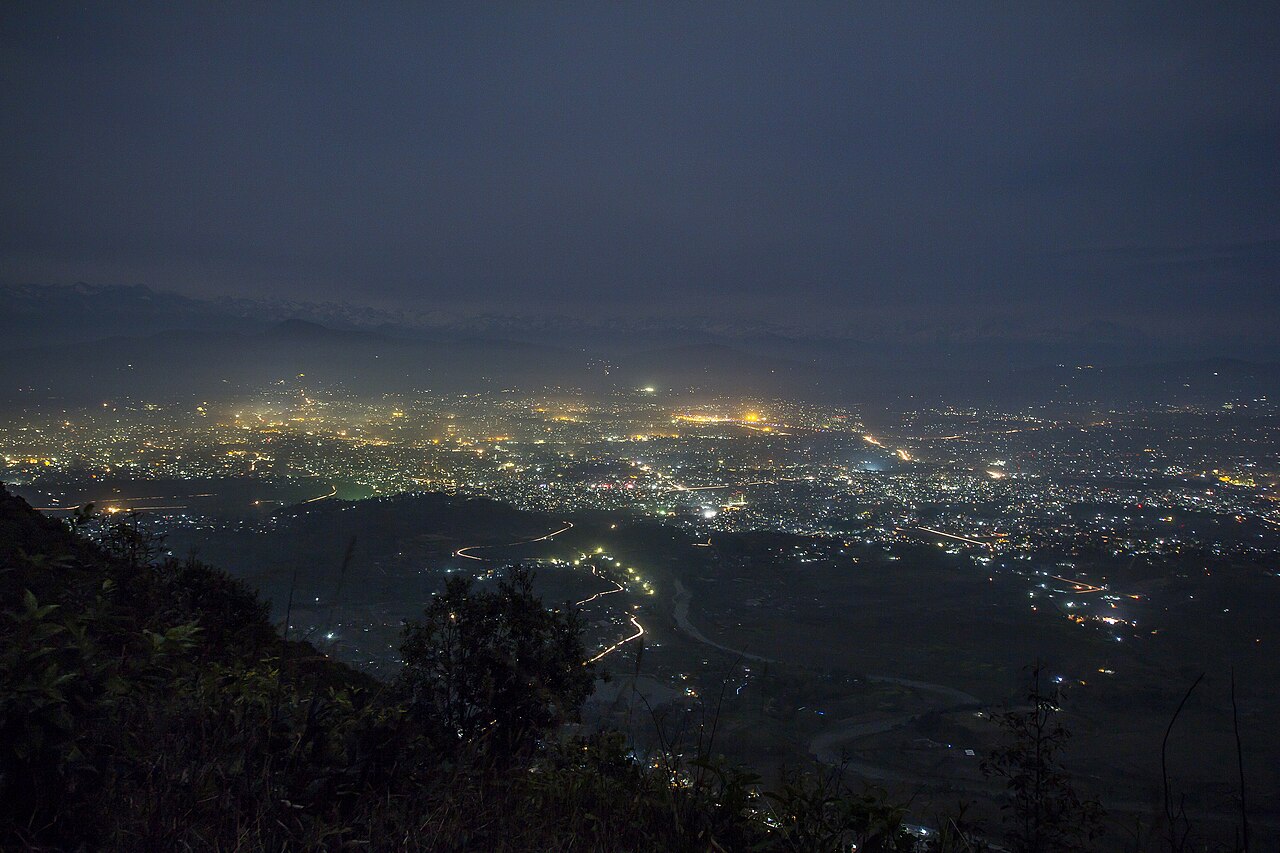
Featured image: Kathmandu city lights photographed from the surrounding hills by Saroj Pandey, via Wikimedia Commons, licensed under CC BY-SA 3.0.
