
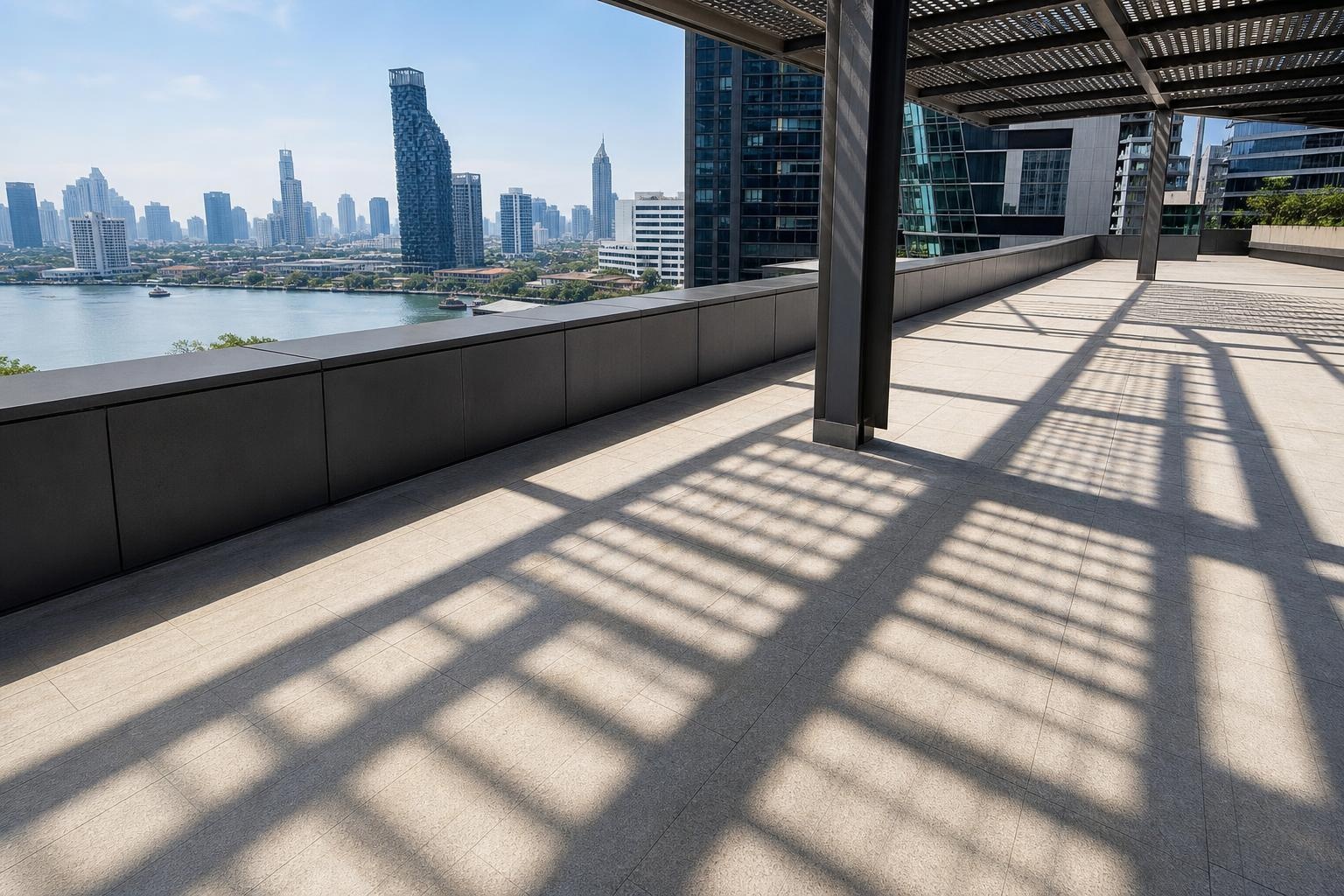
Shade is one of the first things a guest feels on a rooftop, even when it is not the first thing they notice. A terrace may have a dramatic view and attractive furniture, yet a table in direct sun can become uncomfortable long before the food or drinks arrive.
Good rooftop shade design is therefore more than a row of umbrellas. It combines the movement of the sun, the direction of the breeze, the depth of a canopy, the position of planting and the way seats are distributed through the day. In Asian cities, where heat, humidity and sudden rain can all shape an outdoor visit, those layers determine whether a rooftop works only for a short sunset window or remains useful from lunch into the evening.
This guide explains how to read those choices as a guest. It is not a building specification. It is a practical way to understand why one table feels calm and comfortable while another feels exposed.
Shade changes the experience before the decor does
Direct sunlight does more than brighten a table. It heats skin, furniture, flooring, menus and glassware. The World Health Organization notes that reported air temperatures are measured in the shade and that conditions in direct sun can be considerably hotter. That is why a shaded table can feel different even when the weather app shows the same temperature across the whole city. For health-focused guidance during extreme heat, follow the WHO’s current heatwave advice.
Shade also changes how long guests want to stay. A comfortable roof can support a slow lunch, an early drink or a longer conversation. An exposed one may push everyone indoors or turn the visit into a brief photo stop. This is especially relevant when planning a rooftop brunch in Asia, when the sun is higher and the visit is likely to last longer than a quick evening drink.
The four layers of useful rooftop shade
1. Fixed shade sets the dependable zone
Deep overhangs, pergolas, roof extensions and structural canopies create the most predictable shelter. Their value depends on more than size. A canopy must respond to the sun’s angle: a shallow cover may shade a table at noon but leave it exposed in the late afternoon, while a deeper or screened edge can control lower-angle light.
Fixed shade also gives a rooftop a reliable operating core. Guests know where to move when the light becomes harsh, and staff can protect circulation routes, service points and at least part of the seating plan. The strongest layouts make this protected zone easy to find without turning the entire terrace into an enclosed room.
2. Movable shade follows the day
Umbrellas, retractable awnings and adjustable screens add flexibility. They can respond to seasonal sun paths, changing table arrangements and the moment when western light reaches a terrace. Their weakness is equally practical: a movable element may be closed in strong wind, unavailable after rain or positioned to shade one guest while creating glare for another.
For visitors, the useful question is not simply “Is there an umbrella?” It is “Will the shaded section still operate at the time I am booking?” A venue may photograph well with every canopy open but use a more restricted layout when weather conditions change. The same planning logic appears in our guide to rooftop wind in Asia.
3. Planting softens heat and light
Trees and dense planting can filter sunlight, reduce glare and make a hard roof feel less exposed. They do not replace a properly sized canopy, but they can help create cooler-feeling edges and transitions. Singapore’s National Parks Board distinguishes between extensive green roofs, which are generally not designed for active recreation, and accessible roof gardens that can support social use. Its rooftop greenery guidance also stresses that plant selection must respond to intense sun, low soil moisture and rooftop conditions.
That distinction matters for hospitality spaces. Greenery seen from a table is not necessarily providing meaningful shade. Look for actual canopy spread, the density of leaves and whether the planting protects people rather than simply framing the view.
4. Seating turns shade into a real choice
A well-shaded terrace can still fail if all comfortable seats are concentrated in one corner. The best plans distribute options: exposed edge tables for a brief view, deeper shaded seats for longer meals and a sheltered fallback close to the indoor space. Routes between those zones should also remain usable when the sun or rain shifts.
This is why shade and seating should be read together. Our guide to choosing rooftop bar seating looks at conversation, weather and dining needs; shade is the layer that determines how those choices change by hour.
Shade must work with airflow, not against it
On a rooftop, a large solid screen can block late sun but also interrupt the breeze. A fully covered corner may therefore feel warmer than a lightly shaded area with better air movement. Louvres, perforated panels, gaps above planting and canopies with open sides can reduce solar exposure while allowing air to pass.
Singapore’s Building and Construction Authority makes the principle clear in its passive-design guidance: shade outdoor and naturally ventilated spaces, but avoid blocking wind and breezes because air movement also supports thermal comfort. The practical lesson for guests is simple. Do not judge comfort from shade alone. Notice whether the shaded zone feels ventilated or stagnant.
Fans can help, but their presence does not guarantee that every table receives the same airflow. A seat directly beneath a canopy may be protected from sun yet sit outside the useful fan path. When heat is a central concern, it is sensible to ask for a shaded seat near natural or mechanical air movement rather than requesting “outdoor” seating in general.
How to read a rooftop before choosing your table
- Check the visit time. Midday, late-afternoon and sunset shade can fall in completely different places.
- Look beyond the edge. The table nearest the view is often the most exposed to sun, wind and reflected heat.
- Ask what is fixed. A permanent canopy is more dependable than an umbrella that may close when gusts increase.
- Notice the floor. Pale, matte surfaces usually create a different visual and thermal experience from dark stone, metal or highly reflective finishes.
- Find the fallback. A quick route to an indoor or deeply sheltered area matters when weather changes.
- Consider the whole group. Children, older guests and anyone sensitive to heat may need a more protected table than the person making the booking.
Singapore’s Urban Redevelopment Authority highlights shade and ventilation as factors that draw people to outdoor public spaces and influence how long they stay. Its overview of urban thermal comfort and resilience is useful context for understanding why these apparently small design decisions affect real behaviour.
The best shade changes with the hour
At lunch, broad overhead protection usually matters most because the sun is high and the meal can last. Shade over both seats and table surfaces is more useful than a narrow strip that moves away halfway through the visit.
In late afternoon, lower-angle light becomes the challenge. Side screens, planting and the orientation of the terrace can matter as much as the roof above. This is also when glare from neighbouring glass or pale facades may become noticeable.
At sunset, many guests accept a short period of exposure for the view. A thoughtful layout lets them enjoy that moment and then move to a comfortable table without disrupting the evening.
After dark, shade itself recedes, but the surfaces it protected may remain cooler than areas that absorbed sun all day. That stored heat helps explain why two sections of the same terrace can still feel different after the sky has changed.
Good shade does not have to hide the rooftop
The design challenge is not to cover every square metre. A rooftop still needs sky, distance and a sense of elevation. The more useful goal is choice: enough open space to preserve the view, enough protected space to make the venue workable and clear transitions between the two.
That balance becomes even more important where shade also needs to handle rain. Deep covers, drainage, dry circulation and flexible seating should work as one system, as explored in our article on rain-ready rooftop design in tropical Asia. In very hot conditions, the guest’s planning choices remain equally important; our Dubai hot-weather rooftop guide offers a useful decision framework.
A beautiful rooftop may sell the horizon, but shade determines how comfortably people can stay with it. Before choosing the most photogenic table, read the canopy, planting, breeze and fallback together. The better seat is often the one that lets the view remain enjoyable after the first ten minutes.