
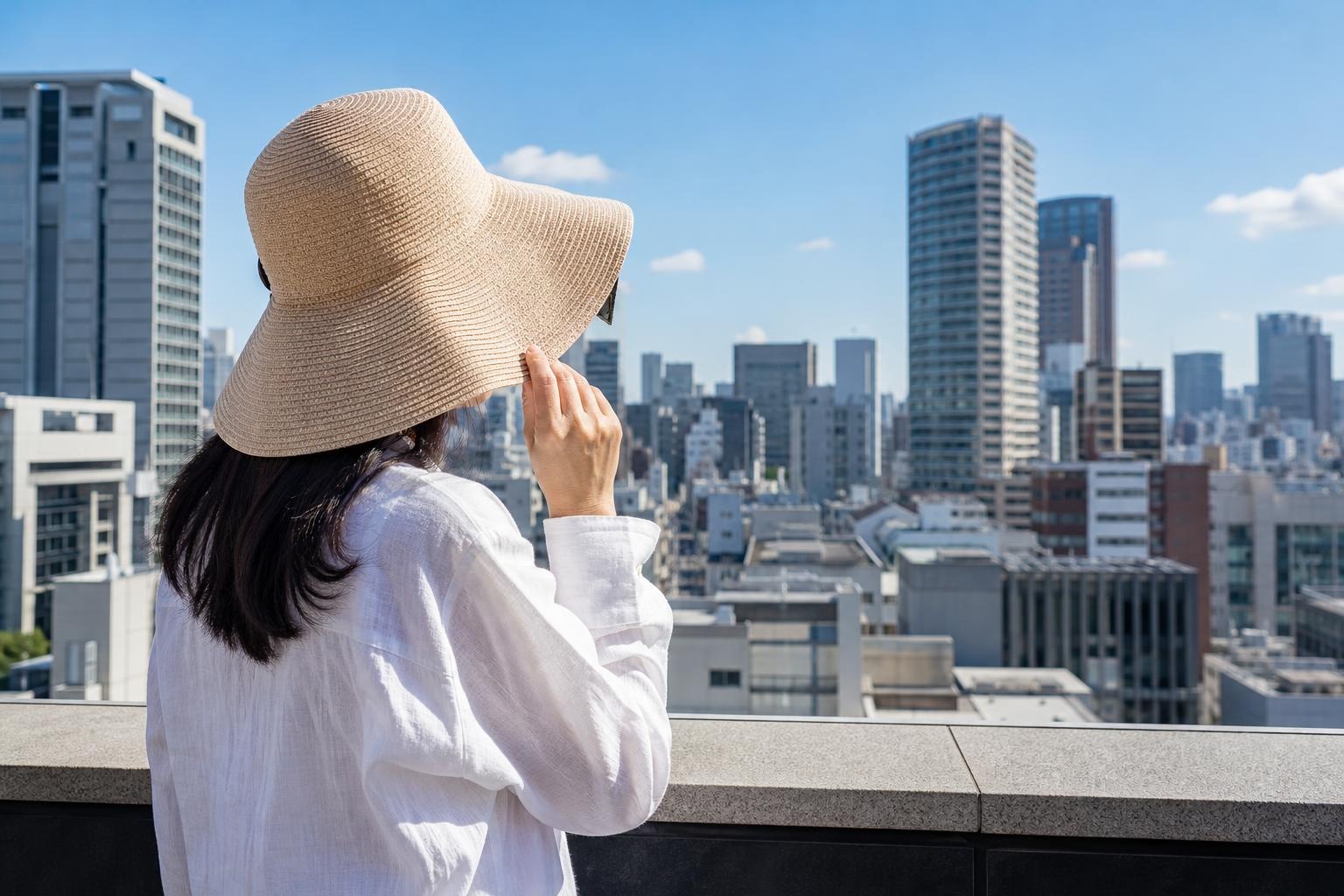
A rooftop can feel comfortable and still expose you to strong ultraviolet radiation. That is the central planning problem for daytime drinks, brunch or an early check-in above the city: temperature, brightness and UV are related to the sun, but they are not the same measure. A light breeze can make a terrace feel cooler without lowering the UV Index, while thin cloud can soften the glare without removing the need for protection.
Good rooftop sun protection in Asia starts before you choose an outfit or pack sunscreen. It starts with the UV forecast, the time of the visit and one practical question for the venue: where will the shade be when you are actually seated?
Read the UV Index, not the mood of the sky
The World Health Organization’s UV Index guidance treats the index as a planning tool. When the UV Index reaches 3 or above, protection becomes relevant; at 8 and above, avoiding the midday sun and seeking shade become especially important.
This matters across Asia because local conditions can produce very high readings. Singapore’s National Environment Agency notes that the UV Index commonly reaches Very High or Extreme levels between 11:00 and 15:00 on days with little cloud cover. The Hong Kong Observatory likewise advises checking both its forecast and current observations rather than judging exposure by how hot the air feels.
A useful rooftop habit is therefore simple: check the local meteorological service on the day, then look again shortly before leaving. Use the maximum forecast to plan conservatively, but remember that real-time readings and cloud conditions may change during the visit.
Separate the UV decision from the heat decision
UV radiation cannot be felt in the way that heat can. A cooler morning, a windy terrace or a hazy-looking sky may still require sun protection. Conversely, an evening with a lower UV Index can remain uncomfortably hot and humid. Treat the two questions separately:
- UV question: How much protection do exposed skin and eyes need at this time?
- Heat question: Will the temperature, humidity and radiant heat make the visit uncomfortable or unsafe?
For the second question, check the official heat forecast and warnings for the city. A rooftop’s breeze is not a substitute for that information. If a heat warning is active, move the visit to a cooler daypart or choose an indoor setting rather than relying on a shaded table alone.
Plan around moving shade
“Outdoor seating available” does not necessarily mean that every table will be shaded throughout your booking. A fixed canopy may protect one side of a terrace in the morning and leave it exposed later. A parasol can be useful, but only if it is permitted, stable in the wind and positioned between you and the sun.
When booking a daytime rooftop, ask a time-specific question: “Is shaded outdoor seating available at 13:00?” That is more useful than asking whether the venue has shade in general. If the answer is uncertain, request an indoor or covered backup rather than assuming that a table can be moved after arrival.
Shade is also a design system, not a binary feature. Canopies, screens, planting and the orientation of seating all change how protection works as the sun moves. The companion guide to rooftop shade design in Asia explains what to notice before accepting a table.
Build protection in layers
No single item does all the work. WHO recommends combining shade with clothing, a hat, sunglasses and sunscreen when protection is needed. For a rooftop visit, that layered approach is more reliable than trying to compensate for a fully exposed table with sunscreen alone.
Clothing first
Lightweight, loose-fitting clothing that covers the shoulders and arms can be practical in strong sun, particularly when the visit will last beyond one drink. A broad-brimmed hat protects more of the face, ears and neck than a narrow visor. Choose pieces that you will keep wearing once the breeze drops and the terrace warms up.
Sunglasses for UV, not just brightness
Dark lenses are not automatically more protective. The Hong Kong Observatory advises checking the UV-filtering performance of sunglasses rather than judging them by colour. This is particularly relevant on pale stone, glass-heavy terraces or near water, where brightness can make people focus on glare while overlooking the protection specification.
Sunscreen as a backup layer
Use a broad-spectrum sunscreen suitable for your skin and follow its label. Apply it before exposure and cover commonly missed areas such as the ears, neck and backs of the hands. The Cancer Council Australia recommends reapplying every two hours while outdoors and after sweating or towel-drying. Sunscreen should support shade and clothing, not justify staying longer in direct sun.
Do not let cloud or breeze make the decision for you
Thin cloud can reduce visible brightness while still allowing substantial UV through. The Hong Kong Observatory notes that broken cloud can sometimes increase exposure through reflection from cloud edges. Haze and cloud also vary quickly over a city, so a grey-looking arrival is not a reason to ignore the measured index.
Breeze creates a similar trap. It can improve comfort and make direct sun feel less intense, but it does not tell you how much UV radiation is reaching the terrace. If a hat is impractical in the wind, that is a reason to rely more heavily on fixed shade, protective clothing and an indoor alternative, not a reason to abandon protection.
Choose the daypart that fits the experience
A rooftop visit does not have to compete with the strongest part of the day. Match the booking time to what you actually want:
- Morning: useful for breakfast, coffee or quieter city views, but still check the UV Index rather than assuming early means low.
- Midday: best approached with confirmed shade, a short outdoor segment and an indoor or fully covered fallback.
- Late afternoon: often easier for a gradual transition into sunset, although UV can remain relevant before the sun drops.
- After sunset: removes the solar UV question, but heat, humidity and weather can still shape comfort.
Make a two-minute arrival check
Conditions on the roof are more useful than assumptions made in the lobby. Before settling in, pause long enough to answer five questions:
- Is the assigned table shaded now?
- Will the sun move onto it during the booking?
- Is there a covered or indoor alternative?
- Do you have the clothing, sunglasses and sunscreen you planned to use?
- Are heat, wind or weather conditions changing the original plan?
If two or three answers are uncertain, change the table or shorten the outdoor portion before ordering. That small decision is easier than trying to solve direct exposure halfway through a meal.
The best rooftop plan leaves room to move
Sun protection is not about turning a rooftop visit into a medical checklist. It is about designing an easier day: check the UV Index, choose the right time, confirm moving shade, dress for the conditions and keep an indoor option available. Those choices let the view remain the memorable part of the visit, rather than the exposure that came with it.